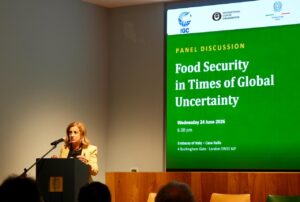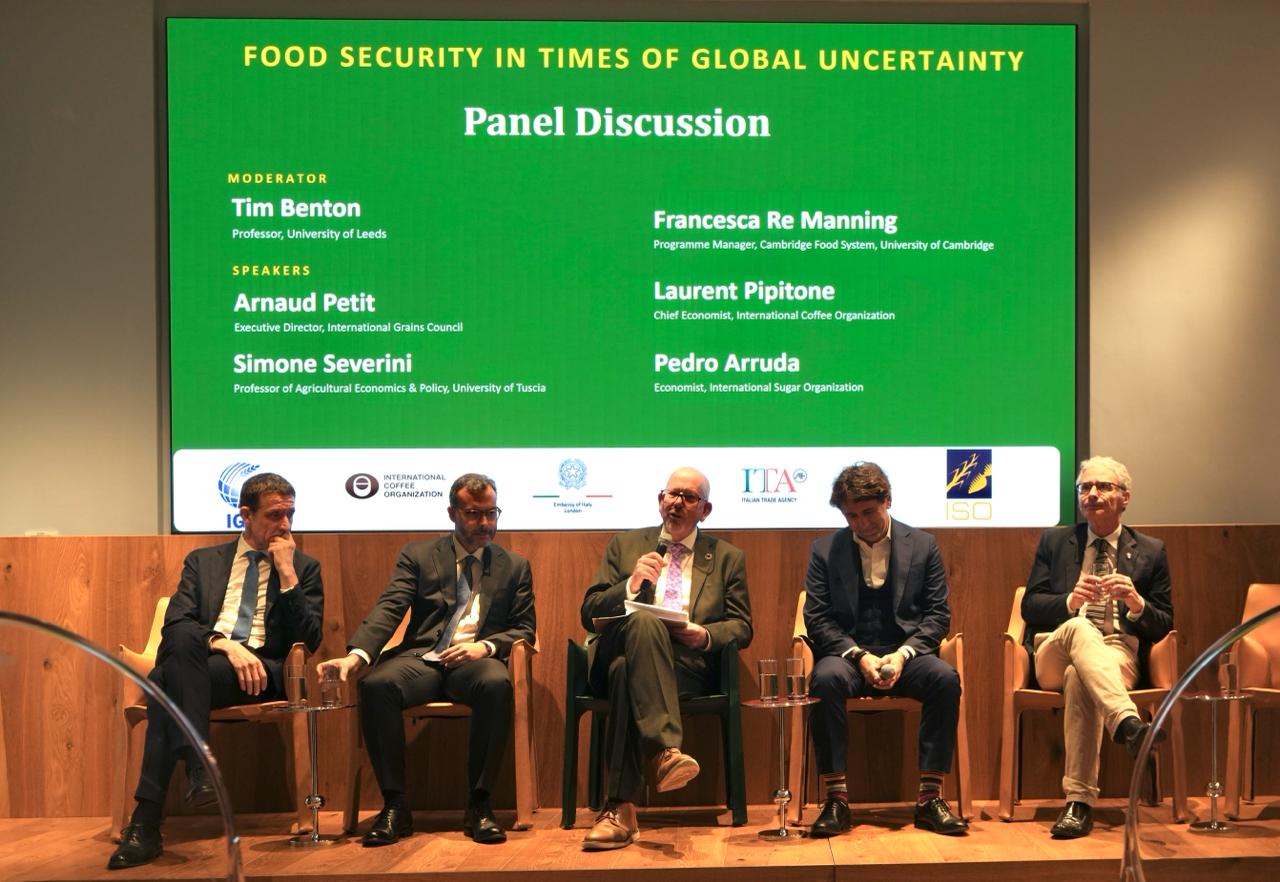
London, 24 June 2026 – The event “Food Security in Times of Global Uncertainty” was held at the Italian Embassy in London, bringing together leading experts to discuss the growing pressures facing global food systems. The initiative was organised by the Embassy’s Agricultural Expert in collaboration with the three London-based International Commodity Organisations: the International Grains Council (IGC), the International Coffee Organization (ICO), and the International Sugar Organization (ISO).
The event was attended by representatives from government institutions, academia, the diplomatic community, and the agri-food sector. Discussions focused on the impact of geopolitical tensions, conflicts, climate-related shocks, and logistical vulnerabilities on agricultural commodity supply chains—from grains and sugar to coffee and other food products—with direct consequences for food availability, affordability, and access.
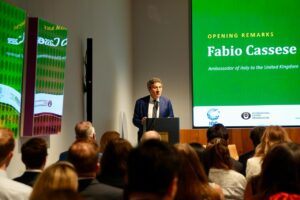
In his opening remarks, Italian Ambassador to the United Kingdom, Fabio Cassese, noted that food security has moved from the margins of policy discussions to the very centre of the international agenda. The same interconnectedness that has delivered efficiency and abundance to global markets has also made them more vulnerable to disruption.
Reaffirming Italy’s longstanding commitment to food security, the Ambassador also recalled Italy’s nomination of Maurizio Martina, current Deputy Director-General of the Food and Agriculture Organization (FAO), for the position of Director-General of the Organisation.
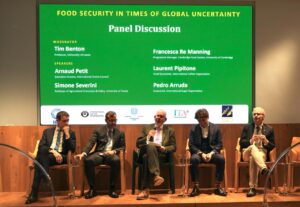
The panel, introduced and moderated by Tim Benton (University of Leeds), brought together Arnaud Petit (IGC), Pedro Arruda (ISO), Laurent Pipitone (ICO), Francesca Re Manning (University of Cambridge), and Simone Severini (University of Tuscia).
The discussion highlighted supply disruptions as the primary source of shocks to agricultural markets, with the war in Ukraine serving as a clear example of their impact on grain prices. Logistical tensions—from the Panama Canal to the Strait of Hormuz—have placed significant strain on global trade routes without causing systemic breakdowns. Participants also noted a shift among importers from a “just-in-time” to a “just-in-case” approach, requiring greater market transparency and stronger trust between countries.
Particular attention was devoted to the vulnerability of sugar and coffee supply chains—both crucial sources of income for millions of farmers and highly exposed to the effects of climate change—as well as to strategies for building more resilient and sustainable food systems. From an Italian perspective, speakers also underscored the importance of “economic” food security, noting that the country’s strong dependence on imports of plant proteins such as soybeans remains essential to sustaining high-quality livestock production chains. Among emerging challenges, the panel highlighted the growing risk of cyberattacks targeting the digital and artificial intelligence systems increasingly used throughout agri-food production and processing.
The event reaffirmed the shared commitment of Italy and its international partners to strengthening the resilience of global food systems through cooperation, transparency, and dialogue, while balancing food security needs with sustainability goals and the ecological transition.
For further information, please contact:
stampa.amblondra@esteri.it